
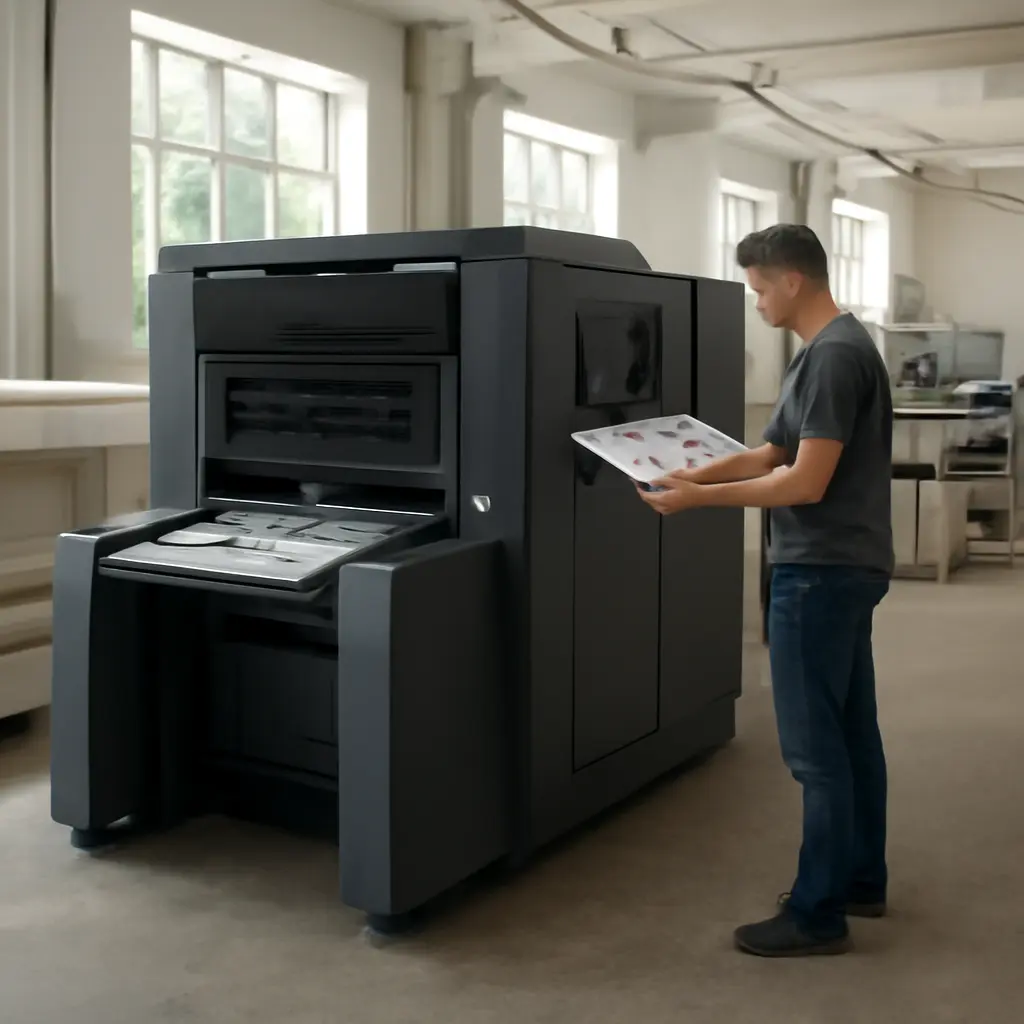
Digital printing technologies are the on-demand production methods that transfer digital files directly onto paper, fabric, and other materials, making it practical to print items only when they are ordered. Improvements in inkjet and electrophotographic presses, color management, and workflow automation have helped print-on-demand (POD) businesses offer more formats, faster turnaround, and short runs without the plates and setup associated with many conventional print processes. The scale of the opportunity is reflected in Smithers’ forecast that the global digital print market will reach $230.5 billion in value by 2032. This article explains the technologies behind POD, how they shape cost and quality, where they are used, and what businesses should consider as they adopt them.
Digital Printing Technologies Enable Print-on-Demand Production
Digital printing is a production process in which image data is sent from a computer-controlled system to a press, which places ink or toner on a substrate without requiring a printing plate for each image. The printing industry uses “digital printing” as an umbrella term for processes including inkjet and electrophotography. Print-on-demand is a production and fulfillment model that uses these capabilities to manufacture an item after an order is received, rather than producing a large quantity in advance.
The distinction matters: digital printing is a technology, while POD is a business and inventory strategy. A POD provider may print one copy of a book or one customized garment, then pack and ship it. This can reduce unsold inventory and make personalization economically feasible, although the per-unit cost may be higher than offset printing for large, standardized runs. Smithers’ market forecast illustrates the growing commercial importance of digital methods, while the practical benefit for individual businesses depends on product, order volume, materials, and fulfillment costs.
Electrophotography: Toner-Based Digital Printing
Electrophotography—often called laser or toner printing—forms an image using electrostatic charges. A laser or LED imaging system creates a pattern on a photoconductor; toner adheres to that pattern and is transferred to the substrate, where heat and pressure fuse it in place. Digital press systems adapt this principle for higher-volume commercial production.
Toner presses are widely used for books, brochures, direct mail, and other jobs that require consistent text and graphics across short or variable runs. Variable-data printing allows each copy to carry different names, codes, or other content while the press continues production. Since there is no plate-making stage, a job can move from approved file to press more quickly than a comparable conventional setup. Performance still depends on the press, paper, finishing requirements, and the complexity of the job.
Inkjet: Drop-on-Demand and Continuous Systems
Inkjet printing deposits liquid ink as droplets onto a substrate. In drop-on-demand systems, the printhead releases droplets only where the image requires them; continuous inkjet systems generate a steady stream of droplets and direct selected droplets to the surface. Commercial inkjet platforms can use water-based, solvent, UV-curable, or other specialized inks, depending on the application and material.
Inkjet’s ability to print across diverse surfaces has expanded POD beyond paper to include labels, packaging, signage, and textiles. Wide-format inkjet, for example, supports individually produced posters and customized graphics. The technology’s strengths include flexible image changes and the potential to print directly onto suitable materials. Its limits include ink–substrate compatibility, drying or curing requirements, and the need to manage color and surface treatment carefully.
Digital Printing Technologies Improve POD Flexibility and Economics
Because digital presses can change image data between copies, they allow POD providers to match production more closely to actual demand. The value is not simply speed: it is the ability to make small, diverse, and personalized orders without holding a large stock of finished goods. These advantages connect the print engine to the wider production system, including file preparation, scheduling, quality control, and shipping.
Short Runs and Lower Inventory Exposure
A short run is a production quantity too small to justify the setup and inventory expense of many traditional methods. Digital printing removes or reduces plate-related setup, so printing a small batch—or a single copy—can be commercially viable. For a publisher, this can mean replenishing a title in modest quantities rather than committing to a large print run. For an online seller, it can mean producing a design only after a customer buys it.
The inventory benefit is a reduction in the risk of unsold printed stock, not a guarantee of lower total costs. POD operators still pay for production equipment or supplier services, materials, packaging, shipping, returns, and platform fees. Businesses should compare total landed cost per order with the cost of bulk production and storage, especially when demand is predictable and volumes are high.
Variable Data and Mass Customization
Variable-data printing changes text, images, or other elements from one printed piece to the next using a connected database or rules-based workflow. It supports personalized books, invitations, product labels, direct-mail offers, and unique QR codes. Mass customization applies this capability at scale: products share a production process but differ according to individual customer choices.
Personalization can make a product more relevant, but it introduces data and quality-control requirements. A POD business must protect customer information, validate incoming files, check variable fields, and ensure that the correct version is assigned to each order. Automated preflight and proofing help prevent errors such as missing fonts, low-resolution artwork, or incorrect names.
Workflow Automation and On-Demand Fulfillment
A digital press delivers the greatest operational value when connected to software that receives orders, prepares files, routes jobs, tracks production, and communicates with fulfillment systems. Web-to-print platforms can standardize product choices and collect print-ready information, while management information systems help schedule jobs and monitor costs. Automation reduces repetitive handling, but it does not eliminate the need for file review, press checks, or accurate shipping data.
A typical POD workflow begins when a customer submits an order and an approved design. The system checks the file, creates a production job, selects a suitable press and material, and sends the finished item for packing and dispatch. Shorter, more predictable handoffs can improve turnaround, but actual delivery time also depends on production capacity, finishing, carrier performance, and the customer’s location.
Digital Printing Technologies Expand POD Applications
As inkjet and toner platforms have developed, POD has spread from document reproduction into products where customization and low-inventory production are valuable. The appropriate process differs by substrate and use case: a book printer has different requirements from a textile decorator or a packaging converter. Matching the press, ink, material, and finishing method is therefore central to product quality.
Books, Manuals, and Educational Materials
Book POD uses digital presses to manufacture titles in small batches or one copy at a time. Publishers can keep a broad catalog available without maintaining large inventories, while authors can test demand before committing to a larger run. The model is particularly useful for specialist, backlist, and frequently revised titles, where demand may be limited or change over time.
A practical example is a technical manual that must be updated regularly. Digital production allows a printer to produce the current edition in limited quantities, reducing the chance that obsolete copies remain in stock. Paper selection, binding, trim size, and color requirements still affect the cost and quality of each copy.
Custom Apparel and Textile Printing
Textile POD commonly uses direct-to-garment (DTG) inkjet printing, direct-to-film (DTF) transfers, or dye-sublimation, depending on the fabric and product. DTG applies ink directly to suitable garments, while DTF prints a design onto film for transfer. Dye-sublimation uses heat to transfer dye into compatible synthetic materials, making it common for items such as polyester apparel and personalized décor.
These methods allow sellers to offer many designs without preprinting every size and color. However, garment composition, pretreatment, wash durability, color matching, and finishing all influence the result. A seller should test representative products rather than assume that the same artwork and settings will perform identically across fabrics and production methods.
Packaging, Labels, and Promotional Products
Digital printing supports short-run packaging and labels for product launches, seasonal campaigns, regional variations, and limited editions. Variable data can add unique codes or language-specific information, while digital production can make multiple versions feasible without separate plates for each design. The same flexibility is useful for promotional items and personalized gifts, provided the equipment can print on the chosen surface.
Packaging applications require particular attention to compliance and durability. Food-contact requirements, abrasion resistance, color consistency, and substrate performance may determine which ink and press are appropriate. Digital printing can simplify versioning, but it does not replace regulatory review or testing under real distribution conditions.
Digital Printing Technologies Require Quality and Sustainability Decisions
POD’s flexibility creates operational choices as well as benefits. Print providers must balance cost, speed, color, durability, and environmental impact across a wide range of jobs. Technology selection should therefore be based on the finished product and order profile—not simply on a press’s maximum speed or advertised capabilities.
Color Management and Print Consistency
Color management is the process of controlling color through the design, display, press, and finishing stages. Calibrated devices, characterized printing conditions, appropriate profiles, and standardized proofs help keep output predictable. Consistency is especially important in POD because separate orders for the same product may be printed at different times or on different devices.
The International Color Consortium develops specifications for color-management systems, including the widely used ICC profile framework. In practice, profiles cannot compensate for every difference in paper, ink, lighting, or finishing. Providers should define acceptable tolerances, use approved materials, and communicate that screen appearance may differ from printed output.
Sustainability and Material Use
POD can reduce overproduction by aligning print quantities more closely with orders, potentially avoiding unsold inventory and disposal. It may also enable localized production that shortens shipping routes in some supply chains. These are potential advantages, not automatic environmental outcomes: a full assessment must account for press energy, consumables, substrate sourcing, packaging, transport, product returns, and equipment utilization.
The U.S. Environmental Protection Agency’s Sustainable Materials Management framework emphasizes considering materials across their life cycle. For POD businesses, useful steps include choosing responsibly sourced or recycled materials where suitable, minimizing packaging, consolidating shipments, and tracking waste and energy. The best option depends on the product’s durability and end-of-life pathway as well as how it is produced.
Choosing a Printing Method for a POD Business
A sound technology decision begins with product requirements and expected demand. Buyers should assess image quality, substrate compatibility, unit economics, capacity, turnaround, finishing, data security, and supplier reliability. A press that excels at one-copy book production may not suit high-volume labels or durable garment decoration.
- Estimate demand and compare the full per-order cost of POD with bulk production, warehousing, and fulfillment.
- Test the actual substrate, artwork, color, and finishing method before launching a product.
- Confirm that order software, file checks, inventory data, and shipping systems integrate reliably.
- Set quality standards for color, registration, durability, packaging, and acceptable production variation.
- Review sustainability claims using measurable information about materials, waste, energy, and shipping.
Conclusion: Digital Printing Technologies Shape the Future of POD
Digital printing technologies—especially electrophotography and inkjet—make print-on-demand practical by removing many setup barriers and enabling short runs, variable data, and customized products. Automated workflows connect these presses to order intake and fulfillment, while applications now span books, apparel, packaging, labels, and promotional goods. Their advantages are strongest when production methods are matched to the product, quality requirements, and demand pattern.
POD is not automatically cheaper or more sustainable in every situation. Businesses should compare total costs, test output, protect customer data, and evaluate materials and logistics across the product life cycle. For further research, review the market analysis from Smithers, color-management guidance from the International Color Consortium, and life-cycle materials resources from the U.S. Environmental Protection Agency before selecting a provider or investing in equipment.
Sources: Smithers, The Future of Digital Printing to 2032, https://www.smithers.com/services/market-reports/printing/the-future-of-digital-printing-to-2032; International Color Consortium, ICC Specifications, https://www.color.org/icc_specs2.xalter; U.S. Environmental Protection Agency, Sustainable Materials Management: The Road Ahead, https://www.epa.gov/smm/sustainable-materials-management-non-hazardous-materials-and-waste-management-hierarchy.


