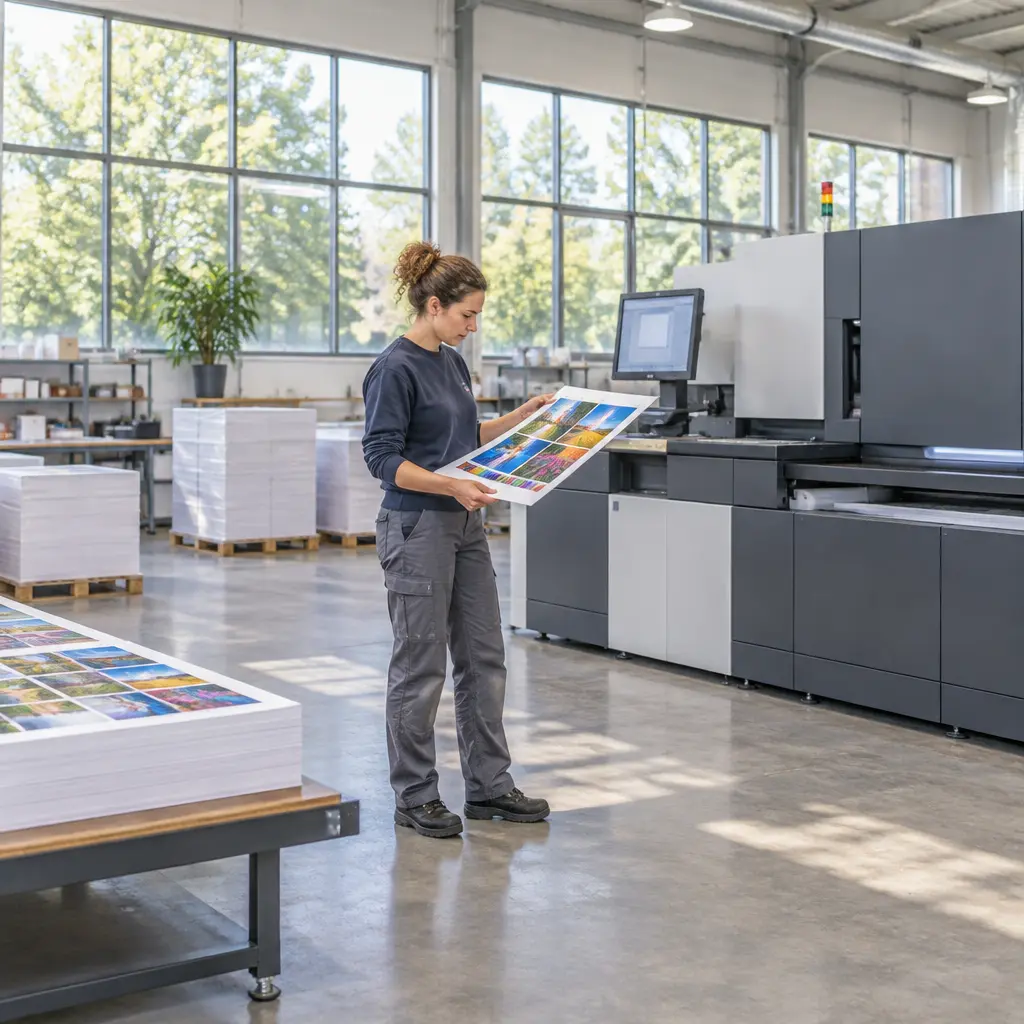
Digital printing, a process that transfers digitally stored images directly onto paper, textiles, packaging, and other substrates, is moving from short-run customization toward broader, data-driven production. Its prospects are supported by demand for personalized products, faster product cycles, and more flexible manufacturing; its challenges include equipment and consumable costs, sustainability pressures, workforce needs, and competition from conventional print. Smithers forecasts that the global digital print market will reach about US$230.5 billion in 2032, up from US$167.5 billion in 2022. The outlook therefore depends not only on printer technology, but also on how firms manage economics, materials, automation, and customer demand.
Digital printing growth reflects changing production needs
Digital printing describes a set of printing technologies that produce images from electronic files without requiring a printing plate for each design. The U.S. Government Accountability Office distinguishes digital printing from conventional processes such as offset lithography, where physical plates are used to transfer an image. Digital methods include inkjet and electrophotographic printing, among others, and can support economical short runs, variable content, and rapid design changes.
The market’s growth reflects a shift in what buyers value: shorter lead times, more versions of a product, and the ability to print closer to the point of demand. Smithers’ forecast indicates a substantial expansion over the decade, although market estimates vary according to which applications, technologies, and related services are included. Growth is not guaranteed: the best production method still depends on run length, substrate, image quality, finishing requirements, and total cost.
Digital printing applications are expanding across packaging, publishing, and textiles
Digital printing’s commercial prospects are clearest where customization, versioning, or production flexibility creates value. Its main application categories include commercial and publication printing, labels and packaging, and décor and textiles. These segments differ in regulation, materials, equipment, and production economics, so growth in one does not automatically translate into growth in another.
Commercial and publication printing
Commercial and publication printing includes brochures, direct mail, books, manuals, and other printed communications. Digital presses allow suppliers to produce shorter runs and update content without preparing a new set of plates. This can reduce the need to hold large inventories of printed materials and can make print-on-demand books and localized campaigns more practical. The trade-off is that high-volume, standardized jobs may remain less expensive on established offset equipment.
Labels and packaging
Digital label and packaging printing enables multiple designs, regional versions, and test launches to be produced in smaller batches. Smithers identifies packaging as an important area of digital-print investment, while industry analyses also point to brand owners’ interest in shorter product cycles and customized packaging. Adoption must nevertheless address food-contact rules where applicable, durability, color consistency, recycling compatibility, and the cost of inks, coatings, and finishing.
Textile, décor, and personalized products
Digital textile and décor printing applies inkjet or other digital processes to fabrics, wallcoverings, flooring, and customized goods. It can support intricate patterns and small production lots while avoiding some of the setup associated with conventional methods. Its prospects depend on reliable color management, pretreatment and finishing, throughput, and the environmental profile of inks and fabric processing. Companies need to compare the full production chain rather than assuming that digital printing alone makes a product more sustainable.
Digital printing technology improves speed, quality, and workflow flexibility
The market’s technical development centers on higher productivity, dependable image quality, wider substrate compatibility, and reduced operator intervention. Inkjet deposits droplets onto a substrate, while electrophotographic systems use charged toner and an imaging process. These technologies are not interchangeable: each has distinct strengths in job length, substrate handling, image characteristics, and operating costs.
Inkjet and electrophotographic advances
Inkjet innovation includes faster printheads, improved drop control, and inks designed for different materials. Electrophotographic systems continue to serve applications where consistent text and image production is important. Smithers’ market analysis tracks investment in both technologies and reports that digital printing is gaining capability across multiple end-use markets. Buyers should validate vendor specifications with production trials, since rated speed may not reflect output after color changes, maintenance, drying, and finishing.
Automation and connected production
Automation links file preparation, color management, press scheduling, inspection, and finishing. A connected workflow can reduce manual steps and make it easier to process many distinct jobs, but it also requires compatible software, accurate job data, and cybersecurity practices. The U.S. National Institute of Standards and Technology emphasizes that connected manufacturing systems create security considerations alongside productivity opportunities. Printers therefore need to treat digital workflow integration as an operational and information-security project, not simply a machine upgrade.
Digital printing economics remain dependent on run length and total cost
Digital printing’s economic advantage usually comes from avoiding plate-making and reducing setup time, rather than from having the lowest cost per impression in every circumstance. Its viability depends on the point at which digital’s lower setup costs offset conventional printing’s scale efficiencies. That break-even point varies with equipment, substrate, ink or toner, labor, finishing, waste, and the number of versions in a job.
Capital investment and consumable costs
A production press can require substantial capital, while ongoing expenses include ink or toner, service contracts, replacement parts, and specialized media. The U.S. Small Business Administration advises firms to account for startup costs and recurring expenses when assessing business investments. For printers, a realistic return-on-investment analysis should include utilization, maintenance downtime, financing, training, and the jobs that can be won or retained—not just the purchase price or quoted maximum speed.
Short-run advantage versus conventional scale
Digital presses are particularly competitive for short runs, customized work, and frequent design changes. Conventional methods may retain a cost advantage when a large quantity of identical items can be produced efficiently. A useful comparison measures the whole job, including prepress, setup, spoilage, inventory, warehousing, and delivery. This is why hybrid print operations often combine digital and conventional equipment instead of replacing one process entirely.
Digital printing sustainability brings both opportunities and trade-offs
Digital printing can support lower overproduction by enabling smaller batches and replenishment closer to actual demand. It may also reduce setup waste for some jobs. However, environmental performance depends on the complete life cycle: energy use, inks and coatings, substrate sourcing, print durability, transport, equipment longevity, and end-of-life recovery. A digital label or package is not automatically recyclable simply because it was digitally printed.
Waste reduction and on-demand production
On-demand production can reduce obsolete inventory when designs change or demand is uncertain. The U.S. Environmental Protection Agency’s waste-management guidance places prevention and source reduction ahead of disposal, making demand-matched production a relevant strategy. Printers can assess its value by tracking overruns, unsold stock, makeready waste, and returned or outdated materials before and after adopting digital workflows.
Materials, energy, and recyclability
Inks, primers, laminates, and coatings can affect recyclability and material recovery. The Association of Plastic Recyclers’ design guidance, for example, evaluates how package components and printing choices interact with recycling systems. Environmental claims should therefore be supported by material-specific evidence and, where appropriate, life-cycle assessment. Operators can also monitor energy and consumables per saleable unit rather than relying on broad claims about one printing technology.
Digital printing faces workforce, supply-chain, and cybersecurity challenges
Modern print production combines mechanical operations with color science, data handling, workflow software, and maintenance. This creates opportunities for higher-value technical roles but also increases the importance of recruitment and upskilling. The U.S. Bureau of Labor Statistics reports long-term employment pressures across several traditional printing occupations as automation and changing media demand reshape the sector; employers need to prepare for those changes while retaining practical production expertise.
Skills and workforce development
Digital print teams need capabilities in prepress, color management, variable-data production, equipment maintenance, finishing, and data security. A transition plan should pair vendor training with cross-training and documented operating procedures. Industry associations and technical colleges can help build pathways, while businesses can use quality and downtime data to identify where additional training will have the greatest operational effect.
Equipment and consumables supply chains
Digital production can be vulnerable to delays in parts, printheads, specialty inks, and proprietary media. Dependence on a limited set of suppliers may affect service response and production continuity. Printers can reduce exposure by reviewing spare-parts availability, service-level agreements, consumable alternatives, and equipment support periods before purchase. These measures matter especially for facilities where a single press supports time-sensitive packaging or customer campaigns.
Data security and file integrity
Variable-data printing often uses customer files, mailing lists, product information, or confidential designs. Networked presses and workflow platforms therefore create risks involving unauthorized access, file substitution, and service disruption. NIST’s cybersecurity guidance for manufacturing recommends identifying assets, managing access, and preparing for incidents. Print businesses should apply those principles through controlled file transfer, access permissions, backups, software updates, and clear retention policies.
Digital printing’s future depends on selective investment and measurable performance
The strongest prospects lie in applications where speed, versioning, customization, or inventory reduction carries measurable customer value. Market growth forecasts provide a useful signal, but they do not guarantee returns for every provider. Before investing, firms should test demand, compare digital and conventional workflows, verify substrate and finishing performance, and model realistic utilization and operating costs.
A practical evaluation can track the following indicators:
- Cost per saleable unit across different run lengths and job types.
- Press utilization, changeover time, downtime, and maintenance expense.
- Waste, inventory levels, obsolete stock, and on-time delivery.
- Color consistency, defect rates, and customer acceptance.
- Energy and consumables per unit, alongside material recovery outcomes.
- Training completion, workflow incidents, and cybersecurity readiness.
Digital printing is becoming a more capable and strategically important production option, especially for short runs, personalized work, and packaging variation. Its future will be shaped by the balance between market growth and operational realities: capital costs, run-length economics, sustainable material choices, skills, and secure connected workflows. Print businesses and buyers should use application-specific trials and transparent performance measures to decide where digital production adds value, then continue monitoring results as technology and customer expectations evolve.
Sources: Smithers, The Future of Digital Print to 2032, https://www.smithers.com/services/market-reports/printing/the-future-of-digital-print-to-2032; U.S. Government Accountability Office, Digital Printing: A New Technology for Producing Printed Materials, https://www.gao.gov/products/ggd-96-152; U.S. National Institute of Standards and Technology, Guide to Operational Technology (OT) Security, https://csrc.nist.gov/pubs/sp/800/82/r3/final; U.S. Small Business Administration, Calculate Your Startup Costs, https://www.sba.gov/business-guide/plan-your-business/calculate-your-startup-costs; U.S. Environmental Protection Agency, Sustainable Materials Management: Non-Hazardous Materials and Waste Management Hierarchy, https://www.epa.gov/smm/sustainable-materials-management-non-hazardous-materials-and-waste-management-hierarchy; Association of Plastic Recyclers, APR Design Guide, https://plasticsrecycling.org/apr-design-guide/; U.S. Bureau of Labor Statistics, Printing Workers, Occupational Outlook Handbook, https://www.bls.gov/ooh/production/printing-workers.htm